Mary Beth Trubitt
Arkansas Archeological Survey, HSU Research Station Archeologist, Arkadelphia
January 2026

Earthen mounds were constructed by Native people in the past across what is now Arkansas. Some supported homes of important leaders or the community’s religious and political buildings, while others served as cemeteries for burials of honored ancestors. Here is the story of one mound and its history as revealed by archeology.
Ancestors of the Caddo people built this and other mounds in southwestern Arkansas. Since they are significant historical places and cultural landmarks for Caddo people today, the Arkansas Archeological Survey consults with the Caddo Nation of Oklahoma administration. This project shows the sophistication and complexity of the ancestral Caddo who lived in present-day Arkansas, Louisiana, Texas, and Oklahoma. Archeology gives a glimpse of the activities and community rituals that took place here during the centuries before European colonization.
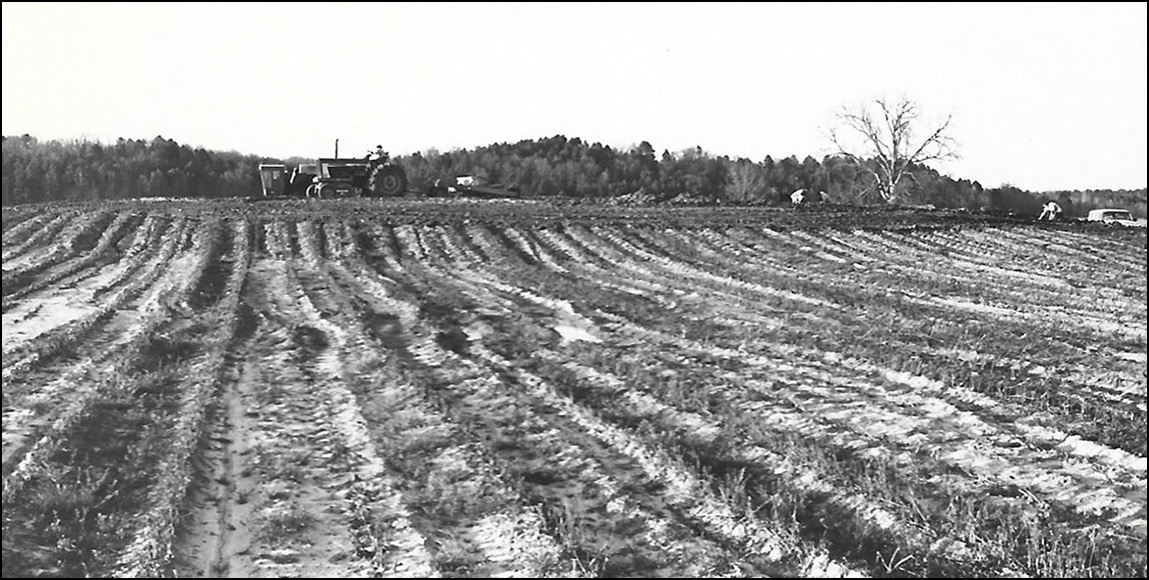
Hays Mound (recorded as archeological site 3CL6) lies in the Little Missouri River drainage in Clark County, Arkansas. Prompted by mound leveling by the farmer in 1970, J. Cynthia Weber (the Arkansas Archeological Survey’s research station archeologist at Henderson State University at that time) conducted salvage excavations at Hays Mound in 1971 to uncover information about its construction, timing, and use before it was damaged further.
""
View north of Hays Mound leveling in 1970 (Arkansas Archeological Survey photograph).
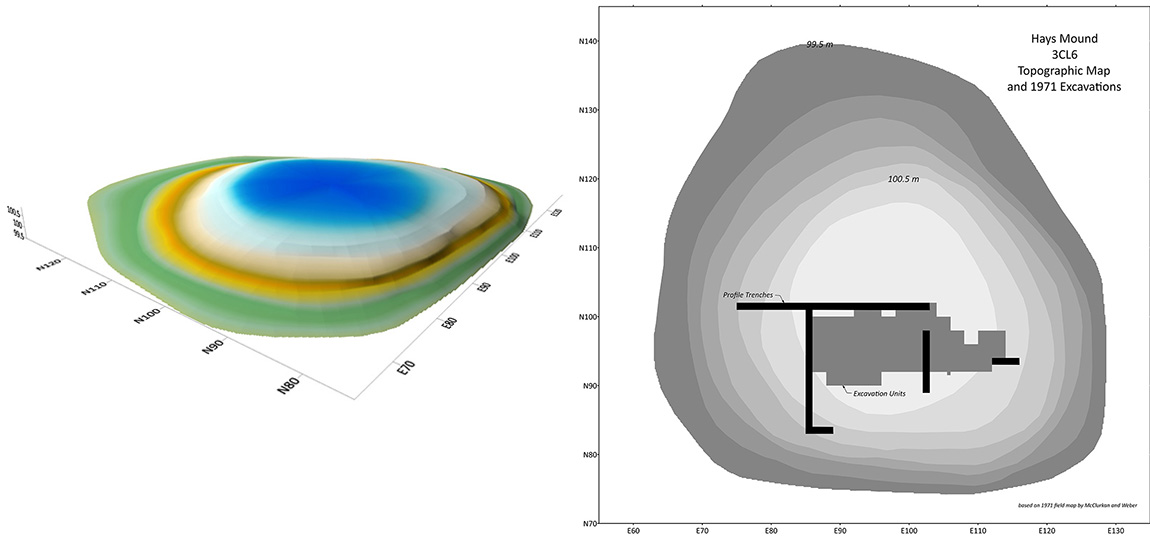
The mound originally stood at about 5.5 m (18´) high with a ramp on its northern side, but by 1971 was only 1.5 m (5´) high. With permission from the landowners and funding from the National Park Service, Weber and a small crew mapped the mound surface, established a grid, and excavated several profile trenches using a backhoe. Following that, they hand-excavated a series of 2 x 2 m (6.5´ x 6.5´) units in a block on the mound’s south side.


""
3-D and 2-D images of mound topography with location of 1971 excavations.
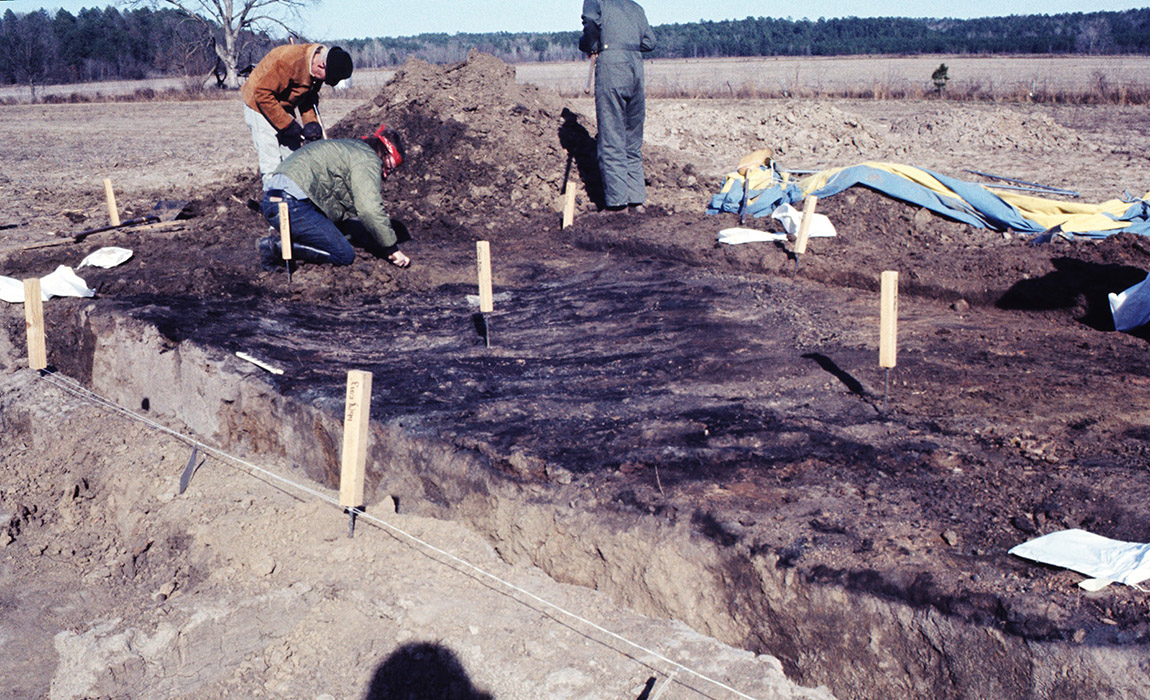
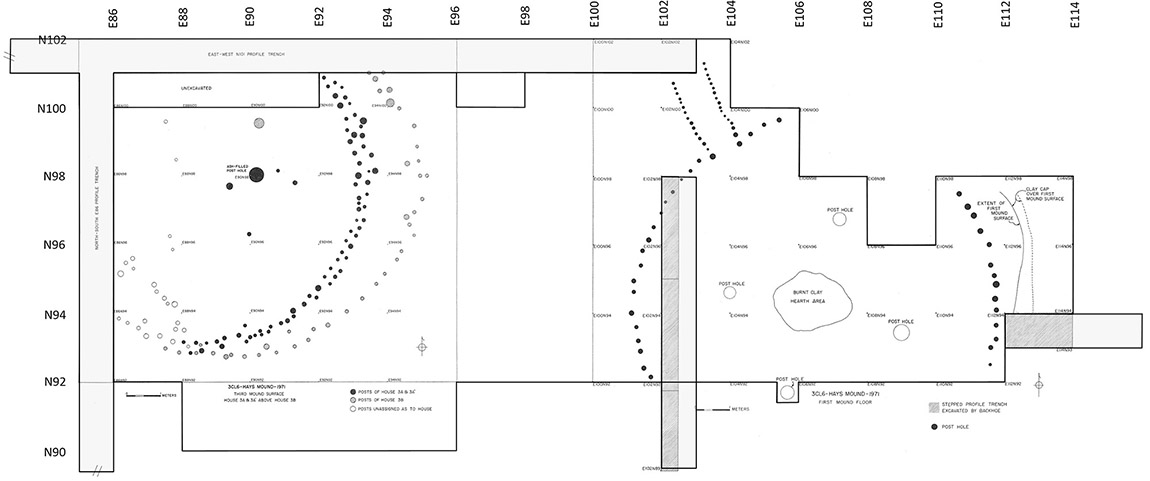
Just below the disturbed top zone, the archeologists discovered burned timbers and remnants of burned structures. They eventually identified portions of five mound surfaces or stages (designated Zero, First, Second, Third, and Fourth Mound). Three of the surfaces had residues of buildings that showed as circular patterns of posts or postholes (designated Zero Mound House, First Mound House, and Third Mound Houses 3A, 3A’, and 3B).
""
Uncovering First Mound Surface in 1971, view to northeast (Arkansas Archeological Survey photograph).
""
Excavation plan with Third Mound House 3A, 3A', and 3B on left (west) and First Mound Structure on right (east) (adapted from Weber’s 1973 report).
While structures were found at about the same depth on the west and east sides of the mound, Weber determined that they were not contemporaneous. The Third Mound Surface with its structures had been added on the west after the original mound had been built up on the east side with its Zero, First, and Second Mound surfaces and structures. The mound had originally been a two-level platform with a lower western side and a higher eastern side. Any Second or Third Mound structures that would have been on the higher east side had already been destroyed by mound leveling.
The buildings buried in the east side of Hays Mound had wall posts in circular patterns measuring 8 m and 10.7 m (26´and 35´) in diameter, with four larger interior posts set around central hearths. While separated by 60 cm (2´) of fill, the hearths and central posts of the Zero Mound and First Mound structures were nearly in the same locations. The First Mound structure was larger and had an extended entryway to the northwest. These structures had been burned and the walls collapsed inward, then covered with earth. On the west side of Hays Mound, three partial circular post patterns (10–14 m or 33–46´ in diameter, Third Mound House 3A, 3A’, and 3B) overlapped one another, with ash deposits and a central hearth/ash-filled post pit.
""
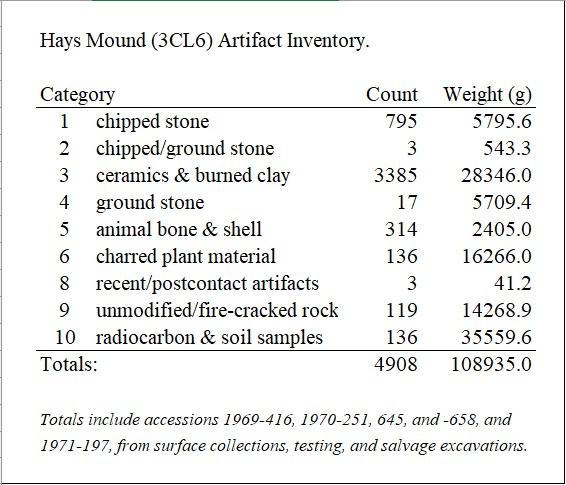
Table showing Hays Mound (3CL6) artifact inventory.
While the structures on the east side had been cleaned out before they were burned, the west side structures had abundant pottery sherds, stone tools, animal bone and mussel shells, and charred nutshell and seeds. To Cynthia Weber, the different treatments at the closure of the buildings indicated different functions; she concluded that the ancestral Caddo leaders’ residences stood on the lower western platform while public or ritual structures were placed on the higher platform on the east.
After fieldwork concluded, Weber completed the analyses and wrote a report. Unfortunately, it was not published or widely disseminated at that time. However, the Arkansas Archeological Survey has curated the artifacts, photographs, and records, ensuring that the project can be looked at again to generate new data and interpretations.
In 2018 and 2019, Ann Early (then Arkansas’s State Archeologist) re-inventoried and reanalyzed the Hays Mound artifacts. In 2023, Aswa Khan and Mary Beth Trubitt (the Arkansas Archeological Survey’s Henderson State University research station archeologist) input the field records and artifact inventory into the Survey’s customized FileMaker Pro program. A total of 4,908 artifacts and samples from Hays Mound have been entered and linked to the state’s Automated Management of Archeological Site Data in Arkansas (AMASDA) database.
""
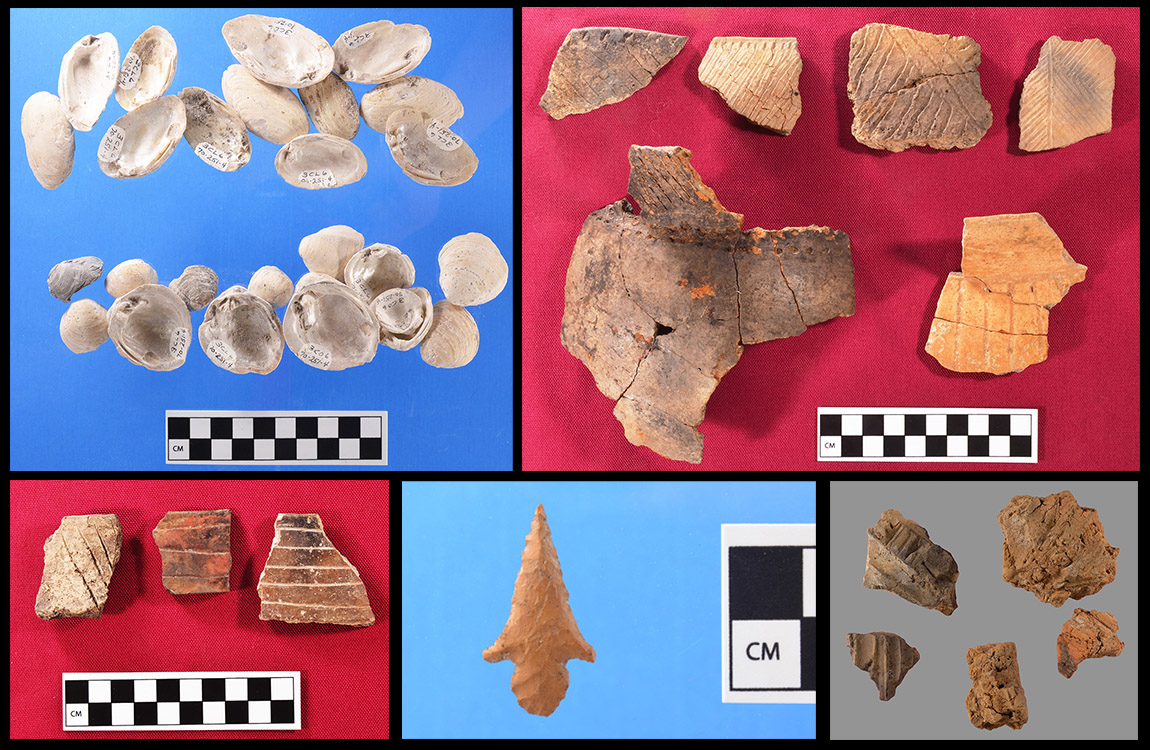
Mussel shells, ceramic sherds, an arrow point, and cane-impressed daub fragments from Hays Mound (Arkansas Archeological Survey photographs).
The most numerous artifacts are those made from clay, including sherds, pipe fragments, and pieces of burned clay or daub. Nearly all the ceramic sherds were tempered either with grog (crushed potsherds) or a combination of grog and small particles of burned animal bone. Some of the sherds were decorated, most often with incised lines. Identified ceramic types include Arkadelphia Engraved, Crockett Curvilinear-Incised, East Incised, Hempstead Engraved, and Pease Brushed-Incised.
Archeologists can identify the shape and often the function of pots from the fragments or pottery sherds from excavations. Pieces of large jars indicate that food preparation and cooking was one activity that took place at Hays Mound.
""
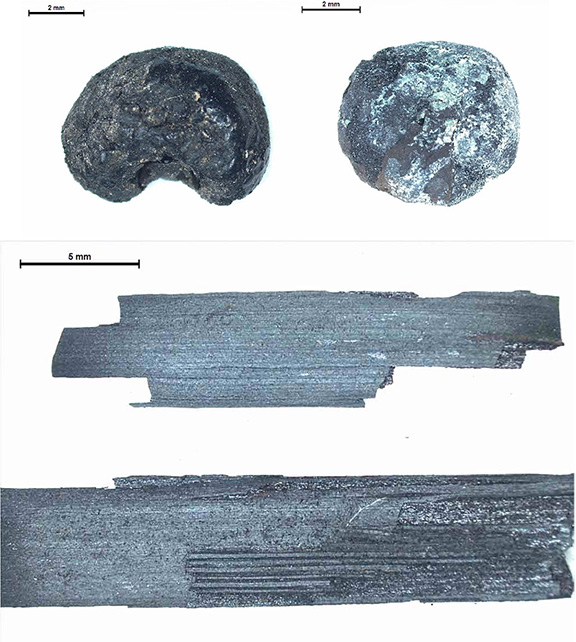
Samples selected for AMS dating: corn (Zea mays) from Third Mound and First Mound Surfaces, and grass (Poaceae) from Zero Mound Surface thatch (photographs by Leslie Bush, Macrobotanical Analysis).
Stone tools chipped from novaculite and chert, along with pieces of chipping debris from tool manufacture and resharpening, are present at Hays Mound. A Hayes type arrow point was found on the Second Mound Surface; this style (not named from this site) is characteristic of Early Caddo period sites across the Caddo area.
Cynthia Weber obtained 13 radiocarbon dates from charred wood and cane from Hays Mound excavations. The dates ranged from AD 1000 to the 1450s, with overlapping results for the Zero, First, and Second Mound surfaces. Weber also sent samples of charred plant material from the excavations to the Missouri Botanical Garden in St. Louis, where Hugh Cutler and Leonard Blake identified domesticated corn as well as hickory, black walnut, acorn, pecan, and persimmon as food resources.
Hays Mound was a key context for Ann Early’s definition of the Early to Middle Caddo period East phase (ca. AD 1100–1350).
In 2024, Mary Beth Trubitt selected and sent six charred botanical samples from Zero, First, Second, and Third Mound Surface contexts to archeobotanist Leslie Bush (Macrobotanical Analysis). She identified specimens and recommended samples for radiocarbon dating. In addition to corn (Zea mays kernels) and grass thatch (Poaceae culms), she also identified seeds (erect knotweed, persimmon, plum/cherry, grape, sumac, and morning glory) and nutshell (hickory, black walnut, and acorn) that may have been from food used by ancestral Caddo people at Hays Mound.
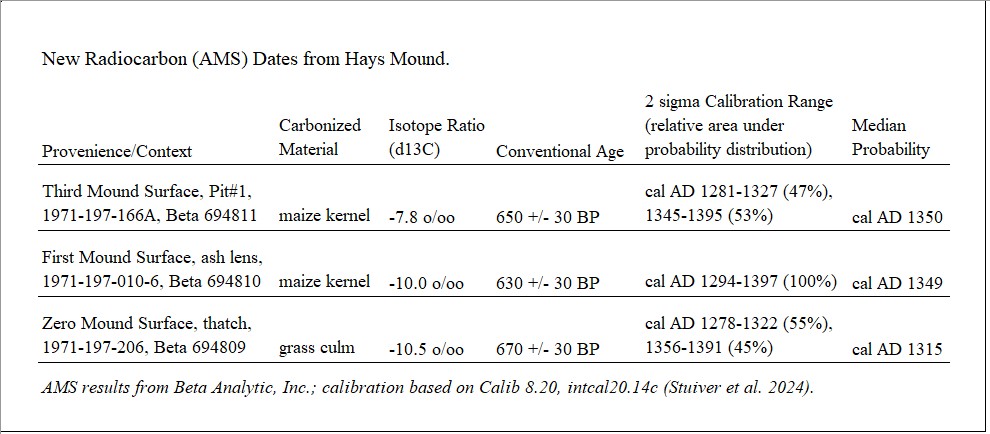
Using the accelerator mass spectrometry (AMS) technique for radiocarbon dating, very small samples of charred plants can now be dated. Trubitt sent three samples—grass thatch from the Zero Mound structure and corn from outside the First Mound structure and from Third Mound House 3B—to Beta Analytic, Inc. Calibration of the conventional ages shows overlapping ranges in the late 1200s to late 1300s, with median probabilities between cal. AD 1315 and 1350.
""
Table showing the new radiocarbon (AMS) dates from Hays Mound.
These results suggest the time span between the earliest and latest constructions was even more compressed than indicated by the previous set of radiocarbon results. The construction and use of Hays Mound took place during the fourteenth century AD, probably over fewer than 100 years. Details of the architecture (the nearly identical placement of the central posts and hearth in the Zero Mound and First Mound structures) and from the pottery (the exclusive use of grog or grog and bone as temper, and the presence of East Incised sherds throughout the sequence) bolster this interpretation.
In the past, ancestors of the Caddo people constructed and used earthen mounds in numerous communities across what is now southwestern Arkansas. Many have been damaged or destroyed in the intervening centuries. Studying curated collections can provide new information without additional archeological excavation. This web page summarizes results of one such reanalysis project. The fourteenth-century architecture buried within the Hays Mound can be compared with that uncovered by excavations at other contemporaneous mound sites. In addition, these results can be used to visualize the community activities that took place at ancestral Caddo mounds that remain in Arkansas and encourage their continued preservation.
This project has been supported by grants from the Caddo Archaeology Research Fund and the Arkansas Archeological Survey’s Hester A. Davis Fund. The 1971 salvage excavations were directed by J. Cynthia Weber with a crew that included Burney McClurkan, Robert Taylor, Jeff Flenniken, Gene Hickman, Ellen Messer, Diane Taylor, Stephen Loring, Meeks Etchieson, Beverly Watkins, Beth Butler, Sam Watkins, Mike Yarborough, Floyd Ciganero, and Paul Schoen. The 2018–2024 reanalysis team included Ann Early, Mary Beth Trubitt, Aswa Khan, and Leslie Bush. Thank you to Caddo Nation Chairman Bobby Gonzalez and Tribal Historic Preservation Officer Jonathan Rohrer for permission and advice on this project. Project notes, records, photographs, and artifact collections (AMASDA Project No. 267) are curated at the Arkansas Archeological Survey’s Henderson State University Research Station in Arkadelphia.
For further reading, see:
Early, Ann M. 2002. Arkansas Prehistory and History in Review: The East Phase. Field Notes, Newsletter of the Arkansas Archeological Society 304:4–8.
Early, Ann M., editor. 1993. Caddoan Saltmakers in the Ouachita Valley: The Hardman Site. Research Series No. 43, Arkansas Archeological Survey, Fayetteville.
Early, Ann M., and Mary Beth D. Trubitt. 2021. Ouachita River Basin in Southwest Arkansas. In Ancestral Caddo Ceramic Traditions, edited by Duncan P. McKinnon, Jeffrey S. Girard, and Timothy K. Perttula, pp. 71–92. Louisiana State University Press, Baton Rouge.
Girard, Jeffrey S., Timothy K. Perttula, and Mary Beth Trubitt. 2014. Caddo Connections: Cultural Interactions within and beyond the Caddo World. Rowman and Littlefield, Lanham, Maryland.
Schambach, Frank F. 1996. Mounds, Embankments, and Ceremonialism in the Trans-Mississippi South. In Mounds, Embankments, and Ceremonialism in the Midsouth, edited by Robert C. Mainfort and Richard Walling, pp. 36–43. Research Series No. 46. Arkansas Archeological Survey, Fayetteville.
Stuiver, M., P. J. Reimer, and R. Reimer. 2024. CALIB Radiocarbon Calibration, version 8.2. Electronic resource, http://calib.org/calib/, accessed September 13, 2025.
Trubitt, Mary Beth. 2009. Burning and Burying Buildings: Exploring Variation in Caddo Architecture in Southwest Arkansas. Southeastern Archaeology 28(2):233–247.
Valastro, S., Jr., E. Mott Davis, and Alejandra G. Varela. 1975. University of Texas at Austin Radiocarbon Dates X. Radiocarbon 17(1):52–98.
Weber, J. Cynthia. 1971. The Hays Mound: A Very Preliminary Report. Field Notes, Newsletter of the Arkansas Archeological Society 76:3–6.
Weber, J. Cynthia. 1973. The Hays Mound, 3CL6, Clark County, South Central Arkansas. Report on research conducted under cooperative agreement between the National Park Service Southeast Region and the Arkansas Archeological Survey. On file, Arkansas Archeological Survey, Arkadelphia and Fayetteville.