Carl Williford, Graduate Assistant to the Arkansas Archeological Survey, University of Arkansas
Artifact of the Month - April 2026
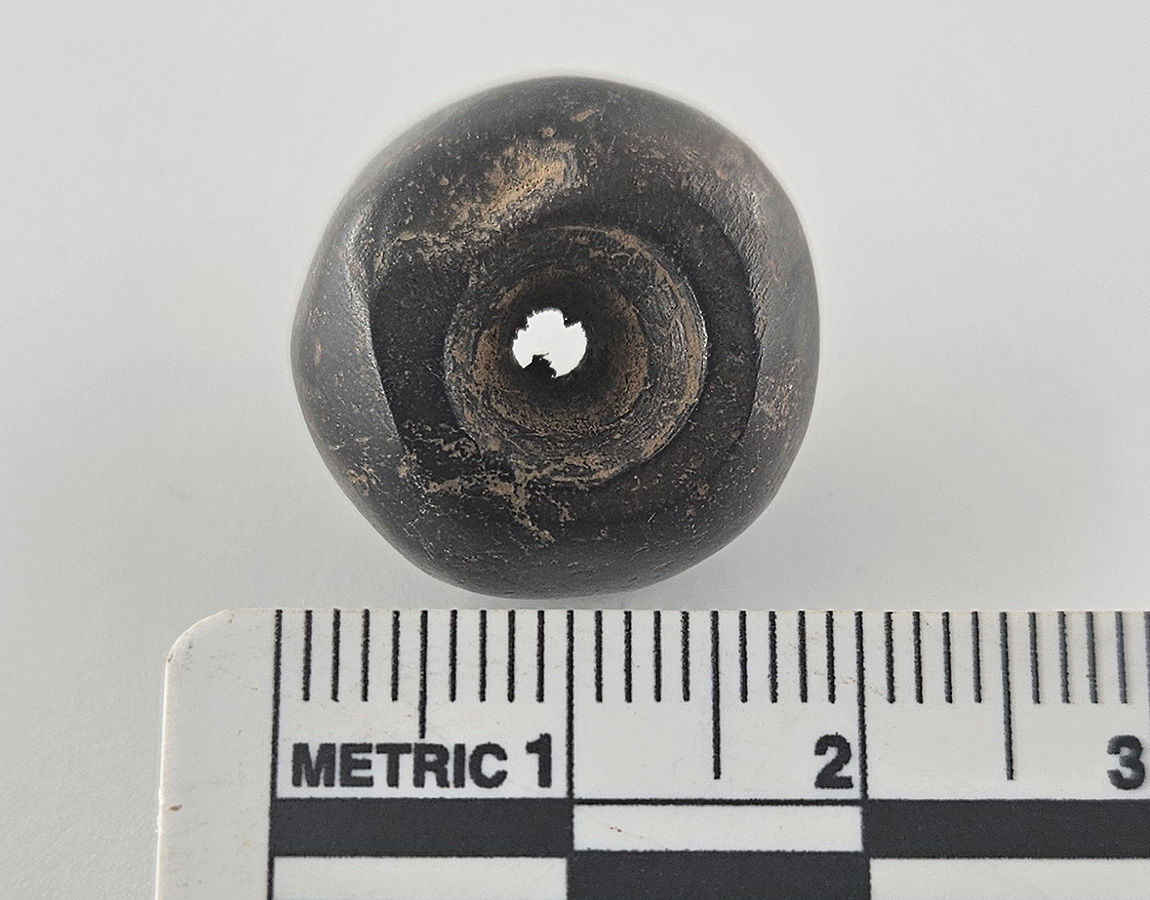
The April artifact of the month is a ground siltstone bead (UA Museum, 87-154-1395) from the Huntsville Mound site (3MA22). The bead measures 1.9 mm in diameter and 1.5 mm long, with a hole 0.4 mm in diameter. Dark brown in coloration, the surface is very smooth despite some pitting. Overall, the bead is slightly asymmetrical at either end of the central hole, with the wider of the two ends having some red coloration to it.
This bead was discovered by Eve Dawkins and L. Shogren during the 1987 Arkansas Archeological Survey (ARAS)/University of Arkansas Field School excavations at the Huntsville Mound site. The Huntsville Mound site is a Mississippian period mound center located in the western Ozark Highlands of Arkansas. Bordered by War Eagle Creek, the site consists of four large mounds arranged on an aggraded rise (Sabo 1986). The bead was recovered from a unit on the southern slope of Mound A, the largest and most extensively documented of the four mounds. It was found along with a projectile point fragment, several biface fragments, and shell tempered sherds during screening of sediment removed from above a prepared floor surface, Dr. Marvin Kay described a charcoal filled pit feature in the same level from which the bead was recovered. The specific function of this pit feature has not been determined, but it was interpreted as a possible post mold or smudge pit.
While there are still questions about the builders and purpose of the Huntsville site, Dr. George Sabo and Dr. Marvin Kay, who both directed the University of Arkansas Field School excavations at the site, argue the site could represent the emergence of prehistoric Caddoan cultural practices in the western Ozark Highlands (Sabo, 1986). The depth and location of the unit this bead was found in places it within the initial occupation phase of the site, circa AD 1000 to 1250. The purpose of Mound A’s construction and continued development appears to have changed throughout the site’s use (Kay and Sabo 2006). Mound A was constructed in phases, with each phase coinciding with the construction of a “residential” or mortuary, Harlan-style charnel house structure (Bell 1972; Kay and Sabo 2006). The exact nature of the structure associated with this bead is still under investigation.

The bead is rather unique in terms of the Huntsville site’s artifact assemblage. Some other small beads were also found at the site, but these were all either ceramic or made from shell or other faunal remains. No other highly polished and worked piece of ground stone has been discovered at the site. Additionally, as the bead was recovered while dry screening the excavated sediment, a more specific spatial relationship between the bead and these features has not been established. However, one interpretation of the pit feature being a smudge pit could point to a ceremonial function for the bead.
***
Materials: siltstone
Dimensions: 1.9 mm in diameter and 1.5 mm long with a 0.4 mm diameter hole
Age Estimate: AD 1000-1250
Courtesy of: University of Arkansas Museum