
""
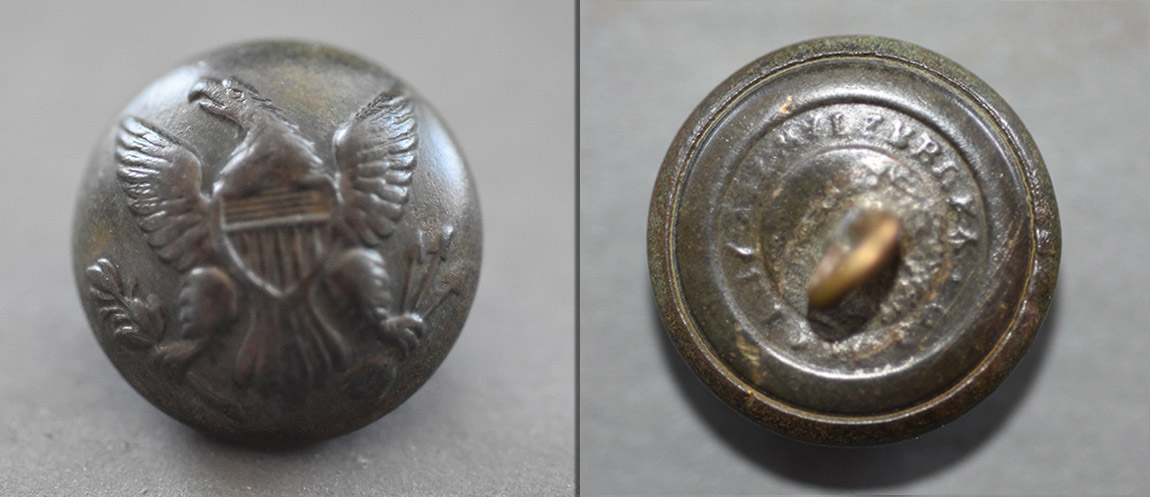
Figure 1. (left) Stamped brass, general service uniform button with American eagle, worn by US Army personnel. Made in Waterbury, Connecticut, nineteenth century. Figure 2. (right) Reverse of US Army stamped brass, general service button, with maker’s mark and WATERBURY stamp.
Carl G. Drexler, SAU Research Station
Artifact of the Month - May 2026
Buttons are such common items. I have fourteen of them on my shirt today. Yet, understood in proper context, they open the door to our past. Our Artifact for the Month for May is actually two artifacts, both buttons, but they are linked by history, so we are only slightly stretching our definition. Both are made of brass and were worn by soldiers.
One is emblazoned with an eagle grasping an olive branch in one set of talons and a spray of arrows in the other (figure 1). It is made of three pieces: the eagle-stamped face, a separate back plate, and a loop shank. There is a maker’s mark on the back, but it is not sharply defined. Still, one can read the word “WATERBURY” pressed into it (figure 2).
""
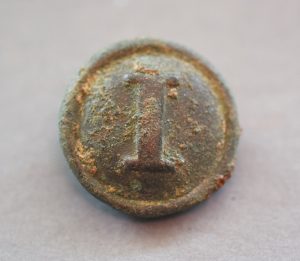
Figure 3. Confederate “I” Infantry brass button, 1863.
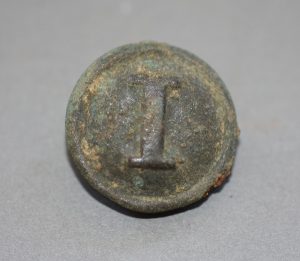
The other button is less ornate. It bears upon it a simple block “I” on its concave surface, which is surrounded on the perimeter by a raised edge (figures 3 and 4). The back is a mass of rust. If there is a shank in there, we cannot see it anymore. Ditto for a maker’s mark. It measures about 2.4 cm in diameter, roughly 15/16".
Both were found on Block Six at Historic Washington State Park during the Arkansas Archeological Society’s summer training program digs in 2011–2012. The eagle button came from the top 20 cm of one of our test units (TU38, to be precise) of the 2011 training program. Based on some of the other materials found in that same level, the top 20 cm of that unit were likely jumbled by human activity, as there was an Archaic period point there along with some more modern debris. The “I” button, by contrast, came from the 15–25 cm level of test unit 13 from the same year. That was a sealed context and was part of the remains of a storefront that would have been standing on Block Six during the nineteenth century.
These are both military buttons. The first (the eagle button) is what we call a “general service” button and was worn by US Army soldiers of all branches (infantry, artillery, and cavalry) during the mid-nineteenth century, including the Civil War of 1861–1865. It was manufactured in Waterbury, Connecticut, home to a button industry that remains in operation today. The “I” button, on the other hand, was issued to a Confederate infantryman. “I” buttons were commonly issued pieces, made locally across the Confederacy,  and—despite their rudimentary layout—varied markedly in their actual layout. This one is most consistent with an example that Warren K. Tice , in his book on Confederate buttons, identifies as being from the “Western Theater,” which would be consistent with where we found it (Tice 1997:217).
""
Figure 4. Another view of the Confederate “I” Infantry brass button.
These are both rare finds. We do not commonly encounter buttons of any variety, but these are from soldiers who spent time in Washington in the mid-nineteenth century. The “I” button would have come from the clothes of a Confederate infantryman who was in the town during the war, when the town served as the Confederate capitol of Arkansas after the US Army took over Little Rock in 1863. Its production and association are very tightly restricted in time. The general service button could be from before the war, as US Army personnel would have been in and around Arkansas as part of garrisons and fortifications much like today. It could also be from after the war, including during the period when Arkansas was occupied by US Army troops sent to ensure Reconstruction went forward as planned and that the emancipation of formerly enslaved Arkansans proceeded. If this were the case, the button could have come from a member of the 12th Michigan Infantry, which spent time in Washington from mid-1865 to early 1866.
These artifacts remain part of the Survey’s collections at the SAU Research Station, in Magnolia, where they will serve as tangible links to the past and one of America’s most painful conflicts.
Reference
Tice, Warren K. (1997) Uniform Buttons of the United States: Button Makers of the Unites States, 1776–1865; Button Suppliers of the Confederate States, 1800–1865; Antebellum and Civil War Buttons of U.S. Forces; Confederate Buttons; Uniform Buttons of the Various States, 1776–1865. Thomas Pubs.

Artifact of the Month Series

A first principle of archeology is that the significance of artifacts depends upon documented information about the context of their discovery. At what site was the artifact found? Can we figure out the age of the artifact? Where was it found in relation to site features (houses, trash deposits, activity areas, etc.) and the distribution of other artifacts? Only with knowledge of those facts can we assess further information about the manufacture and use of artifacts, and their role in other spheres of activity such as social organization, trade and exchange, and religious practice.
In this series, we feature select artifacts that are extraordinary both for the context of their discovery and for their unique qualities that contribute exceptionally important information about Arkansas culture and history. New artifacts will be added monthly. Find the list of artifacts here.