
""
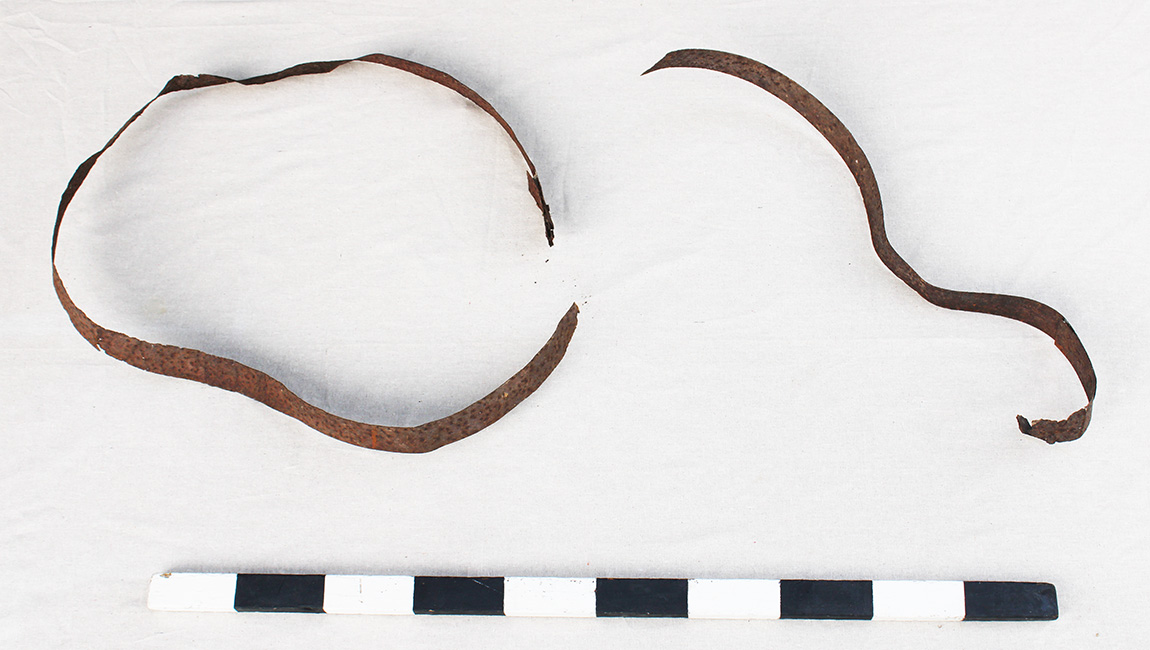
Figure 1. Two iron moonshine barrel hoops found in a bluff shelter on Petit Jean Mountain.
Ashley Hansen
Artifact of the Month - August 2026
Although the artifacts photographed here may appear to be unremarkable scraps of metal, they are a testament to the ever-changing landscape of the Seven Hollows region of Petit Jean Mountain (Figure 1). These iron barrel hoops were likely used for moonshine production and are relics of the mountain’s infamous Prohibition-era bootlegging activity. They are bent, broken, and rusted after enduring roughly a century on the ground’s surface.
Petit Jean Mountain (though technically a mesa rather than a mountain) lies about  20 miles northwest of Morrilton in the Arkansas River Valley. The Seven Hollows region sits on the southwest slope of the mountain and is named for its array of towering 200-ft sandstone canyons (Lane 1974). In varying ways, people across history seem to agree that the Seven Hollows region is a place worth visiting. This area boasts the highest concentration of precontact rock art on the mountain. In 1907,  the area was protected from logging and preserved as public land (ADPHT Staff 2026). Since then, the region has become home to two high-traffic hiking trails, dozens of beloved rock-climbing routes, and a smattering of illegal Prohibition-era moonshine still sites—the source of the artifacts discussed here.
""
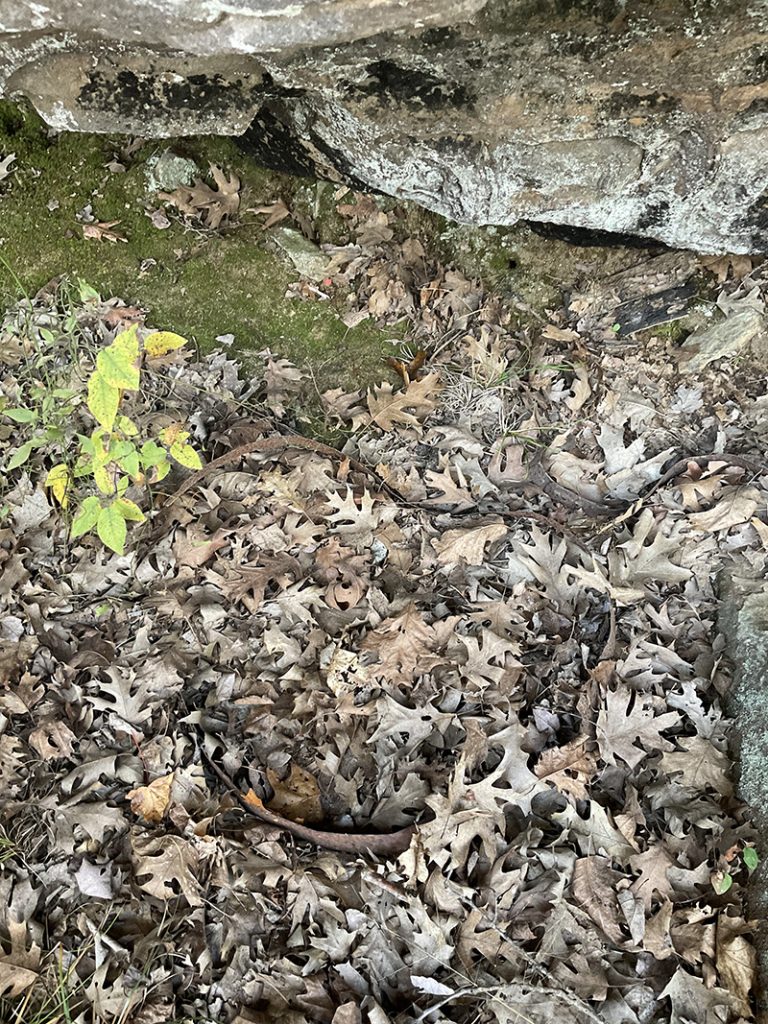
Figure 2. In situ photo of barrel hoop.
The ratification of the Eighteenth Amendment in 1919 ushered in Prohibition, outlawing the manufacture, sale, and distribution of alcohol. This brought about profound change in the mountain community. According to local physician and community advocate Dr. T.W. Hardison, owners of local farms and sawmills closed their operations to pursue illicit moonshine production in Seven Hollows. Monumental canyon walls and hidden bluff shelters served as the perfect setting for these activities. Moonshine stills quickly appeared in nearly every hollow, and mountain citizens, whether they intended to or not, had frequent run-ins with bootleggers (Lane 1974; Sisco 1994).
Moonshine distillation proved to be a lucrative career for enough people that bootlegging continued even after Prohibition ended in 1933. Moonshiners had no trouble finding business both on and off the mountain, and notably even found loyal clientele in the enrollees at the Civilian Conservation Corps (CCC) camp just a few miles up the road (Lane 1974; Sisco 1994).
While it is unknown exactly when the stills of Seven Hollows fell out of use, the popularity of the practice steadily declined and was eventually abandoned in the region altogether. Valuable distilling equipment disappeared and wooden barrel staves slowly decomposed into the earth, leaving only crude stone structures, rusty metal equipment, and public memory to attest to the once widespread bootlegging operation.
Out of all the artifacts associated with moonshining in Seven Hollows, our iron barrel hoops reflect the changes and constants that the region has endured over time. Even after moonshining disappeared from Seven Hollows, the canyons still found a way to attract those with an apathy for rule-following. Although you’ll often hear Petit Jean State Park staff instructing visitors to stay along the marked trail, curious minds have always wandered for one reason or another. In the latter decades of the twentieth century, a discreet yet flourishing rock-climbing culture emerged in the hidden corners of Seven Hollows despite official park rules barring the practice. Seven Hollows remained a place where people carried out their activities within the secrecy of the canyon walls.
A few years ago, Petit Jean State Park began the process of developing authorized rock-climbing routes and associated trails in Seven Hollows, one of which passed through areas with documented moonshine still sites. In fall 2025, to protect the material culture of these sites before they were made easily accessible to the public, Arkansas Archeological Survey staff retrieved the barrel hoops and other associated objects and moved them to curation. Although this still site had been known by mountain locals for decades and was even officially recorded as an archeological site in 2011, these iron objects had remained virtually unmoved on the ground’s surface (Figure 2). How many off-trail hikers, rock climbers, archeologists, picnickers, birders, and countless others noticed their presence over the years?
Today, the authorized rock-climbing routes and their associated trails are visited daily by the public, bringing traffic to an area once only populated by those with a defiance for the rules. Our barrel hoops serve as a reminder of the many ways humans have used Seven Hollows over time—and that change is one of the few constants in its history.
References and further reading:
Arkansas Department of Parks, Heritage, and Tourism. (2026). Petit Jean State Park . In Encyclopedia of Arkansas. Central Arkansas Library System.
Hardison, T. W. (1955). A Place Called Petit Jean: The Mountain and Man’s Mark . Carden Bottom Publishing Co.
Hardison, T.W. (1955). Interview by George Reynolds, transcript, Hardison Collection, Arkansas State Archives
Hardison, T.W. (1974). Petit Jean Mountain: T.W. Hardison, interview by Hal Lane, partial transcript and recording, University of Arkansas at Little Rock Center for Arkansas History and Culture, Johnye Strickland Collection 1891-2012.
Sisco , G. (1994). Georganne Sisco Interview with Janice and Ladd Davies. other.

Artifact of the Month Series

A first principle of archeology is that the significance of artifacts depends upon documented information about the context of their discovery. At what site was the artifact found? Can we figure out the age of the artifact? Where was it found in relation to site features (houses, trash deposits, activity areas, etc.) and the distribution of other artifacts? Only with knowledge of those facts can we assess further information about the manufacture and use of artifacts, and their role in other spheres of activity such as social organization, trade and exchange, and religious practice.
In this series, we feature select artifacts that are extraordinary both for the context of their discovery and for their unique qualities that contribute exceptionally important information about Arkansas culture and history. New artifacts will be added monthly. Find the list of artifacts here.