Taylor Greene, ARAS-SAU Research Station
Artifact of the Month - February 2026
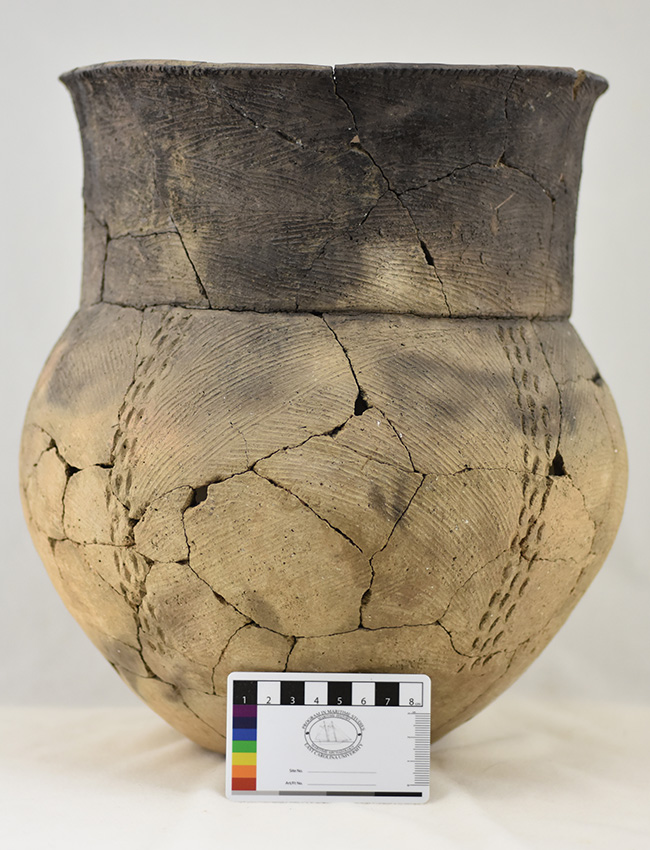
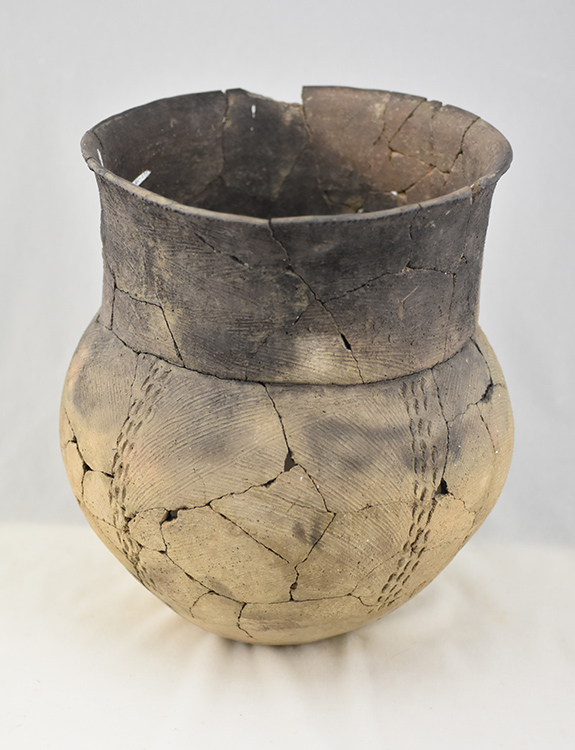
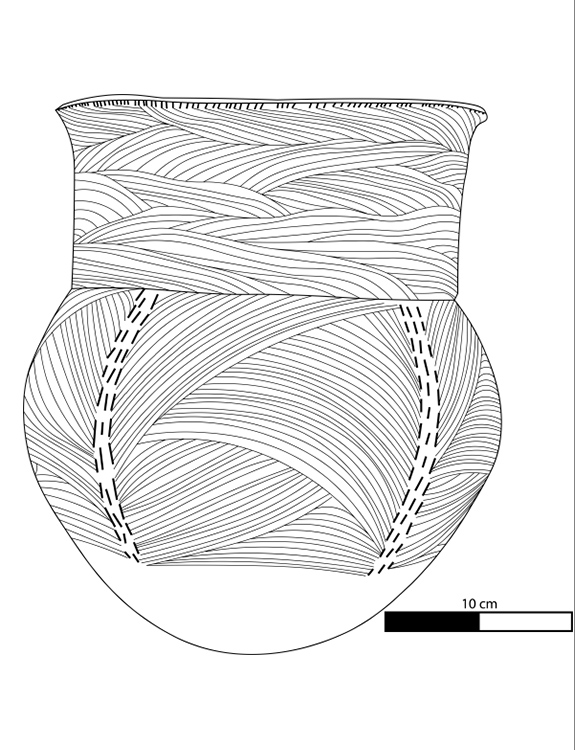
Pictured here is a Caddo long-necked storage jar, it stands about 30.7 cm tall, weighs around 3.5 kgs, with an orifice diameter of 24.3 cm. It is decorated with three distinct techniques. First, there are vertical notches on the lip of the jar; second, there are the overlapping brushed designs covering both the rim and body; finally, the artist added columns of short vertical punctations that divide the jar into five sections. The temper in this jar is grog and shell.
This jar was recovered as a part of the 1987 Training Program in Archeology at Georgia Lake, a mound-less Caddo village site located on a terrace above the Ouachita River in Ouachita County, and the project that year was being led by Dr. Ann Early. While excavating in the southern portion of the midden that was the focus of the excavation that year, a feature (designated Feature 7) was discovered and immediately recognized as being a storage pit containing this vessel. As the feature was only partially within a unit, a small 1-m-x-1-m unit was excavated to accommodate the full extent of Feature 7. The excavators also collected soil samples from within and outside the jar. This vessel was later reconstructed under the supervision of Dr. Early.
Prior to the Fall of 2025, age determinations for 3OU112 were mostly done via estimations and comparisons to other sites. Through these comparisons, we knew that the site itself was a Caddo site after light testing prior to the Training Program, likely belonging to an early aspect of what Dr. Early describes as the Middle Ouachita region. Since then, however, thanks to grants from the Hester A. Davis Grant Program within the Survey and the Society’s Archeological Research Fund, three AMS samples were selected by Dr. Elizabeth Horton as a part of a macrobotanical analysis on other flotation samples. These samples were dated and calibrated by the University of Georgia Center of Applied Isotope Studies. One of these samples came from the soil within Feature 7 (but not the jar itself), and was dated to between cal. AD 1321-1358 (2σ range, 60.9% certainty). Which puts the Feature within the transition between the East Phase (ca. AD 1100 to 1350) and the Mid-Ouachita Phase (ca. AD 1350 to 1500).
This jar is one of very few complete vessels from the site, and the only one of these complete vessels that is not associated with a burial at the site. Insofar as understanding the roles of different kinds of pottery at the site and among these Caddo, this artifact shows the form that utilitarian wares took at the site, and that this form is very different from the fine ware forms made by potters at Georgia Lake. Additionally, this vessel (and its context) shows how these utilitarian wares were actually used, in this case as a container for long-term storage within a storage pit, one of the very few examples of this practice within the Caddo world.