""
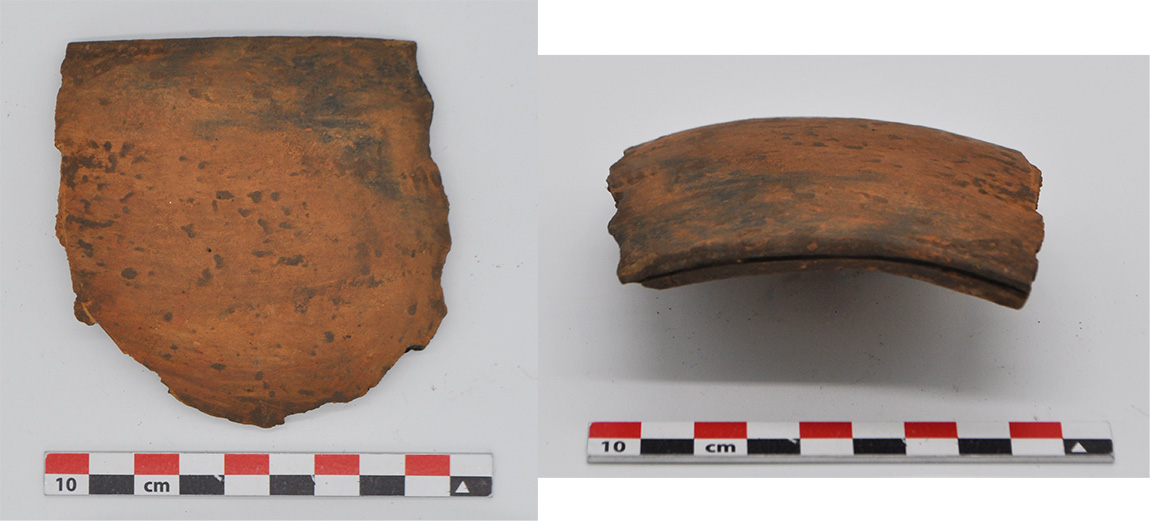
Figure 1. Coles Creek Incised (var. Keo) sherd. Incised decoration on rim shown on right.
Dr. Paige Ford, Station Archeologist (PBMRS)
Artifact of the Month - June 2026
Even the most ordinary looking ceramics can tell us a lot about the human past. As potters build a vessel—adding temper, shaping and forming the clay, and applying decoration—they leave behind traces of the process of making a pot. Striations from smoothing the vessel, carefully and deliberately incised designs, and pieces of temper mixed into the clay itself all record how the ceramic artisan manipulated these materials to make that vessel. Additionally, when the vessel is used for cooking, serving, or storage, those processes leave physical evidence on the interior and exterior of the pot. You can sometimes see sooting, from when a pot was placed in or near a fire, along with stirring marks—or even carbonized residues of past meals—preserved on the inside of the vessel. Archeologists look for all this evidence to reconstruct the story of the people who made and used these objects.
Our June artifact of the Month is thus a Coles Creek Incised (var. Keo) sherd (2025-39-117) from Plum Bayou Mounds (3LN42) (Figure 1). It was uncovered by Dr. Emily Bartz and Brittany Bostian (ARAS-UAPB) during the 2025 Arkansas Archeological Society’s Annual Training Program. We find ceramics like this one commonly at Plum Bayou Mounds, and Coles Creek Incised is a widely recognized type throughout the Woodland period in the southeastern United States (Ford et al 1941; House 1987, 1990, 1996; Phillips 1970; Phillips et. al. 1951; Rolingson 1990, 1998, 2012; Morse and Morse 1990). But while this might not be a particularly “special” find on its own, it offers important insight into the activities of Plum Bayou peoples at this ceremonial center during the period when the site was built and used (650-1050 AD).
By analyzing the artifact itself, we can learn a lot about how it was made and even a little about how it was potentially used. Pieces of grog (crushed up pottery) and dried clay were mixed into the clay as temper, and the vessel was constructed using the coiling method, in which potters joined individual coils together to build up the vessel's walls. The surfaces were smoothed and burnished (lightly polished) with a polishing stone. The potters decorated the vessel with a single incised line along the lip and used a red film – likely made from hematite pigment – on the exterior surface. Films and clay slips may have served some functional purpose, such as making vessels water resistant or sealing their surfaces, but their highly visible red color suggests they were also valued by Plum Bayou people as a decorative element.
""
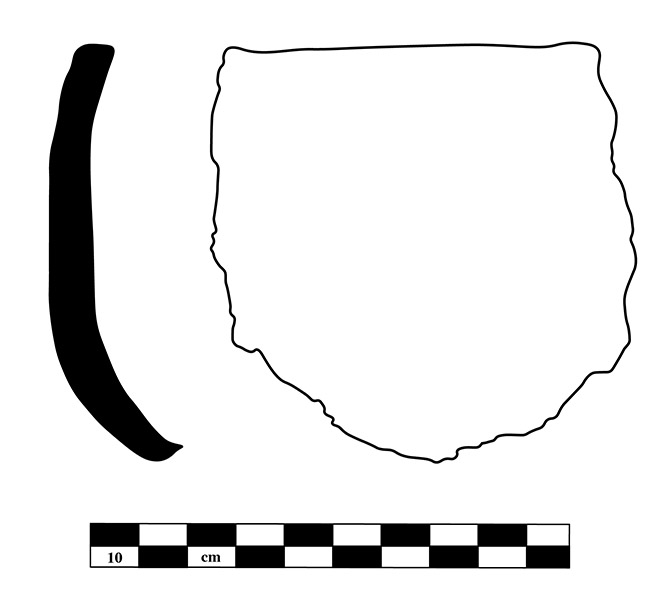
Figure 2. Profile of Rim curvature (left) and sherd sketch (right)
Based on the profile or side view of the rim, this vessel was likely a bowl with an orifice (opening) diameter of approximately 20 cm or 7.87 inches (Figure 2). Bowls are commonly thought to be serving vessels, though this vessel form may also have been used in food preparation. There is sooting on the vessel’s interior and the exterior surfaces, indicating that at some point this vessel was in close proximity to a fire.
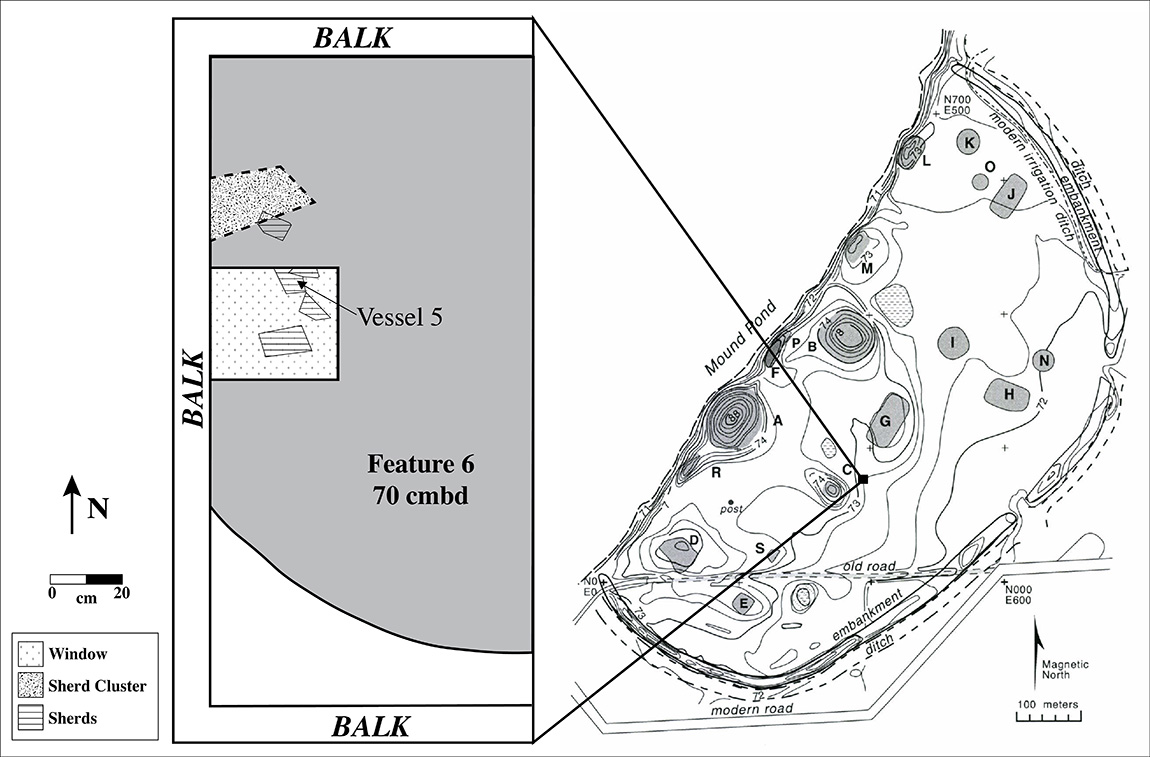
Putting the artifact in its context—where it was found and what it was found with—can reveal even more insights into its significance for Plum Bayou peoples. This sherd was found among several others in an area adjacent to the southern plaza between Mounds C and G—an area hypothesized to be a feasting pit. Excavations here revealed part of a circular or ovate pit. Feasting or trash pits such as this one are incredible places to excavate, as they provide archeologists with a lot of data about subsistence, food preparation, technology, and more within a relatively small window of time and space. They can also offer important insights into the gatherings of these communities, especially since these mound centers were primarily built for communal feasts that brought these dispersed populations together.
Inside this pit (also known as Feature 6), archeologists found dark greasy soils with an increased clay content, along with loads of burned material, including charcoal, and burned clay, and burned pottery, bone, and lithics. In one area, there was a dense accumulation of large, carbonized ceramic sherds stacked on top of one another. This deposit included our artifact of the month, known as Vessel 5 (Figure 3). The area was carefully excavated, and the ceramics preserved so that residue analyses could be conducted alongside paleoethnobotanical analysis and carbon dating. Together, these analyses on ceramics like Vessel 5 create a more complete picture of the activities represented at the site, giving us a “snapshot” of the lives of Plum Bayou peoples—revealing what they were eating, how foods were prepared, the vessels used to serve them, and when these activities took place.
""
Figure 3. Sherd cluster and Vessel 5 in context.
Two radiocarbon dates from Feature 6, located adjacent to the sherd cluster, indicate these activities date to approximately AD 773–893 and AD 782–881, placing them within some of the earlier phases of site activity. In particular, Feature 6 dates to roughly the same time as similar pits found underneath Mound G (Rolingson 2012). No identifiable bone was recovered from the feature, aside from  small flecks of highly degraded or burned bone. Paleoethnobotanical analyses indicate the processing and use of a range of plants, including walnut, persimmon, maygrass and other grasses, little barley, Chenopodium (goosefoot), Rubus seeds (e.g., blackberry, raspberry, dewberries, bristleberries), and spurge seeds. Some of these plants were used for food, some for fiber for making basketry and more, and others used for medicinal purposes. This is consistent with what we already know about Plum Bayou peoples. They relied on a mixed subsistence strategy, cultivating native domesticated crops, harvesting nuts, hunting and fishing, while also gathering many other resources for use in their daily lives. They were drawing upon abundant plant and animal resources all around the river valley (Colburn 1987; Fritz 2008; Fritz and Connaway 2023; Hoffman 1982, 1998; Kelly 2012; Nassaney and Hoffman 1992; Rolingson 1992, 1998, 2012; Smith 1996; Styles et al 1985).
Archeologists are also constantly experimenting with new methods to glean even more from our analyses. Organic residue analysis (ORA) and compound specific isotope analysis (CSIA) are new techniques used in reconstructing the types of resources cooked, stored, or served in different kinds of pottery (Reber 2022). By conducting residue analyses on ceramics such as Vessel 5 from Feature 6, we can begin to better understand what Plum Bayou peoples were cooking and eating at Plum Bayou Mounds and, more importantly, reconstruct what types of vessels were used to cook, store, and serve specific resources. These analyses use mass spectrometry to extract and identify chemical compounds (i.e., lipids) that are preserved within the ceramic matrix of the pottery. Without such data, archeologists have no basis for interpreting the specific functions of particular vessel types. In Plum Bayou contexts, we can also use ORA to directly compare pottery use in ceremonial versus domestic settings, which is important for reconstructing a more complete picture of Plum Bayou cultural lifeways.
The ORA on the vessels from Feature 6 was done at the University of North Carolina at Wilmington Archaeological Residue Laboratory by Dr. Nora Reber. Results from Vessel 5 showed indicators for fish or shellfish resources, mixed with other resources like terrestrial animals. This vessel contained the only residue, in our small sample from Feature 6, showing multiple indicators for fish or shellfish, distinguishing it from the rest of the sampled vessels, suggesting that fish was at some point cooked or served in this vessel (Reber 2026). While we currently do not have enough data to argue that fish and shellfish were exclusively used in this type of vessel, the distinction is noteworthy and provides a basis for developing additional hypotheses to be tested as we gather more data.
What we can tell from Vessel 5, its context, and the data gathered from the surrounding area is largely consistent with what we already know about Plum Bayou peoples’ activities at Plum Bayou Mounds. We frequently find bowls like the one represented by Vessel 5. Existing evidence indicates that Plum Bayou people were cultivating native plants, hunting terrestrial animals, and fishing. We know Plum Bayou people were feasting at this site, which means they were likely cooking and serving food in vessels like this one. Previous research also indicates that they likely put their trash from these feasting events —such as broken bowls, food remains, and other debris—into pits and middens like Feature 6. In this sense, Vessel 5 is not a particularly unprecedented find.
However, Vessel 5 provides an important example of how archeology is always changing and innovating new techniques, allowing for more nuanced interpretations of the past. Organic residue analysis (ORA) is a new analytic technique that draws on methods from chemistry to extract and identify compounds from ceramics. These compounds are primarily lipids, which can be broadly categorized as plants, terrestrial animals, or fish/shellfish. Compound-specific isotope analysis (CSIA) can refine these results by identifying contributions from specific plant resources, such as maize. Although ORA and CSIA require a lot of training to implement and interpret within archeological contexts, they give us a better glimpse into the use of these ceramics and how food was cooked, served, and stored within them. Vessel 5 was definitely used to cook or serve fish or shellfish, which distinguishes it from the other sampled vessels in Feature 6. Now we can take that information forward in our research on Plum Bayou ceramics.
So, next time you hold a sherd in your hand, no matter if it is undecorated or highly embellished, just think about the story it holds about the human past!
Bibliography

Colburn, Mona L. 1987 Faunal Exploitation at the Ink Bayou Site. In Results of Faunal Testing for Significance at the Ink Bayou Site (3PU252), Pulaski County, Arkansas, by D. B. Waddel, J. G. House, F. B. King, M. L. Colburn, and M. K. Marks, pp. 235-249. Arkansas Archeological Survey Project No. 557. Submitted to Arkansas Highway and Transportation Department, Little Rock.

Ford, James A. and Gordon R. Willey 1941 An Interpretation of the Prehistory of the Eastern United States. American Anthropologist 43(3):325-363.

Fritz, Gayle J. 2008 Plum Bayou Foodways: Distinctive Aspects of the Paleoethnobotanical Record. Arkansas Archeologist 47:31-41.

Fritz, Gayle J. and John M. Connaway 2023 Reframing the Question of Baytown Food Production: Plant Remains from the Oliver site, northern Yazoo Basin, Mississippi. Southeastern Archaeology 42(2):105-121.

Hoffman, Robert W. 1982 Animal Resource Exploitation Patterns at the Toltec Site: A Zooarcheological Study of the Mound D sample. Unpublished Master’s thesis, Department of Anthropology, University of Arkansas, Fayetteville.

1998 The Faunal Material. In Toltec Mounds and Plum Bayou Culture: Mound D Excavations, by M. A. Rolingson, pp. 84-93. Research Series No. 54. ARAS, Fayetteville, Arkansas.

House, John H. 1987 Aboriginal Ceramics. In Results of Faunal Testing for Significance at the Ink Bayou Site (3PU252), Pulaski County, Arkansas, by D. B. Waddel, J. G. House, F. B. King, M. L. Colburn, and M. K. Marks. Arkansas Archeological Survey Project No. 557. Submitted to Arkansas Highway and Transportation Department, Little Rock.

1990 Powell Canal: Baytown Period Adaptation on Bayou macon, Southeast Arkansas. In The Mississippian Emergence, edited by Bruce D. Smith, pp. 9-26. Smithsonian Institution.1996 East-Central Arkansas. In Prehistory of the Central Mississippi Valley, edited by Charles H. McNutt, pp. 137-144. University of Alabama Press, Tuscaloosa.

1996 East-Central Arkansas. In Prehistory of the Central Mississippi Valley, edited by Charles H. McNutt, pp. 137-144. University of Alabama Press, Tuscaloosa.

Kelly, Lucretia S. 2012 Faunal Remains From Mound S, Toltec Mounds Site. In Toltec Mounds: Archeology of the Mound-and-Plaza Complex, by M. A. Rolingson, pp. 123-151. Research Series No. 65. ARAS, Fayetteville, Arkansas

Morse, Dan F. and Phyllis Morse 1990 Emergent Mississippian in the Central Mississippi Valley. In The Mississippian Emergence, edited by Bruce D. Smith, pp. 153-173. Smithsonian Institution.

Nassaney, Michael S. and Rob Hoffman 1992 Archaeological Investigations at the Fitzhugh Site (3LN212): A Plum Bayou Culture Household in Central Arkansas. Midcontinental Journal of Archaeology 17(2):139-165.

Phillips, Philip 1970 Archaeological Survey in the Lower Yazoo Basin, Mississippi, 1949-1955. Papers of the Peabody Museum of Archaeology and Ethnology, Vol. 25, Harvard University, Cambridge.

Phillips, Philip, James A. Ford, and James B. Griffin 1951 Archaeological Survey in the Lower Mississippi Alluvial Valley, 1940-1947. Papers of the Peabody Museum of Archaeology and Ethnology, Vol. 25. Harvard University, Cambridge.

Reber, Eleanora A. 2022 An Archaeologist’s Guide to Organic Residue Analysis in Pottery. The University of Alabama Press, Tuscaloosa.

Rolingson, Martha A. 1990 The Toltec Mounds Site: A Ceremonial Center in the Arkansas River Lowland. In The Mississippian Emergence, edited by Bruce D. Smith, pp. 26-48. Smithsonian Institution.

1992 Excavations of Mond S at the Toltec Mounds Site: Preliminary Report. Arkansas Archeologist 31:1-30.

1998 Toltec Mounds and Plum Bayou Culture: Mound D Excavations. Research Series 54, Arkansas Archeological Survey, Fayetteville.

2012 Toltec Mounds: Archeology of the Mound-and-Plaza Complex. Arkansas Archeological Survey Research Series No. 65, Fayetteville.

Smith, Christopher J. 1996 The Analysis of Plant Remains from Mound S at the Toltec Mounds Site. Arkansas Archeologist 35:51-76.

Styles, Bonnie W., James R. Purdue, and Mona L. Colburn 1985 Analysis of Faunal Remains. In The Alexander Site, edited by E. T. Hemmings and J. H. House, pp. 58-75. Arkansas Archeological Survey Research Series No. 24, Fayetteville.


Artifact of the Month Series

A first principle of archeology is that the significance of artifacts depends upon documented information about the context of their discovery. At what site was the artifact found? Can we figure out the age of the artifact? Where was it found in relation to site features (houses, trash deposits, activity areas, etc.) and the distribution of other artifacts? Only with knowledge of those facts can we assess further information about the manufacture and use of artifacts, and their role in other spheres of activity such as social organization, trade and exchange, and religious practice.
In this series, we feature select artifacts that are extraordinary both for the context of their discovery and for their unique qualities that contribute exceptionally important information about Arkansas culture and history. New artifacts will be added monthly. Find the list of artifacts here.