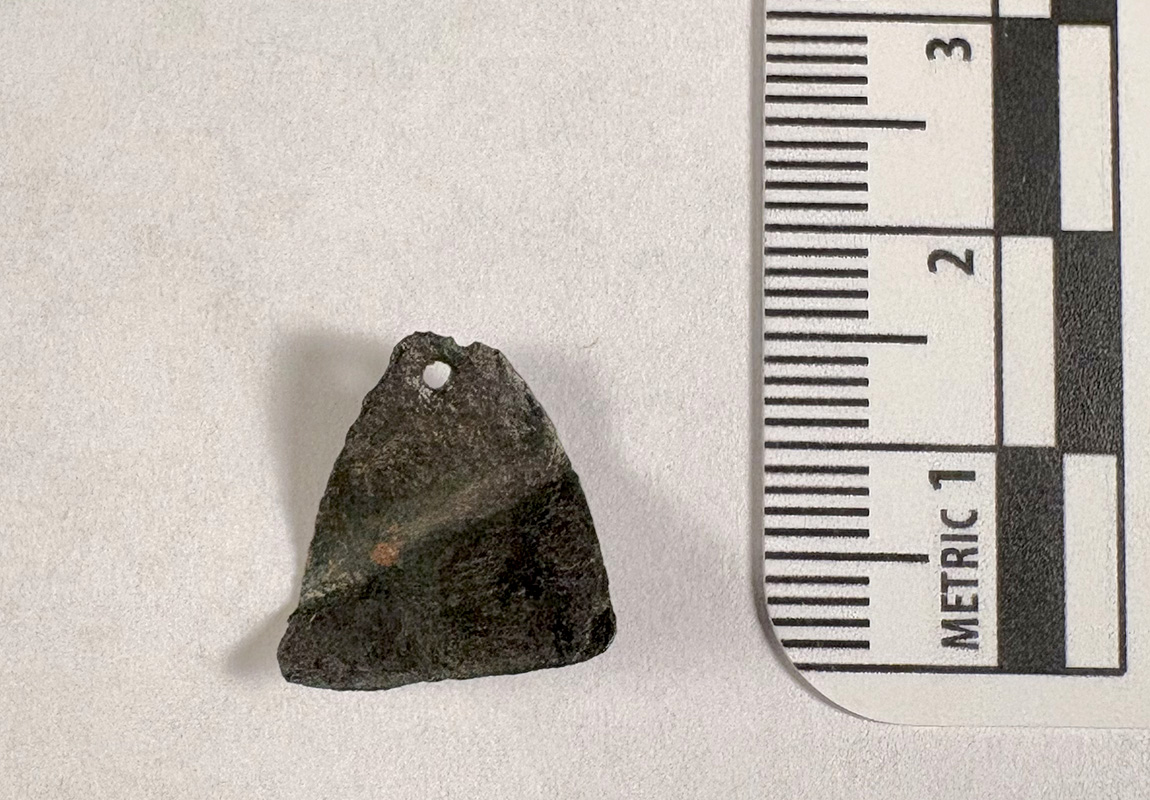
Figure 1: A triangular brass pendant recovered from the Sarassa Lake site (3LI79) in Lincoln County (Photograph by Matthew Rooney)
Matthew P. Rooney and John R. Samuelsen, Arkansas Archeological Survey Artifact of the Month - January 2026
This small, brass, triangular pendant (Figure 1) was recovered through metal detector survey from the Sarassa Lake site (3LI79) in March of 2025. The Lincoln County site was an Indigenous town that is known to have been occupied between the middle 1400s and early 1600s. There were at least 27 small house mounds present at the site, but over the last century these have been used as fill for the nearby Arkansas River levee and have otherwise been spread out to make a flat, agricultural surface, which is actively planted today.
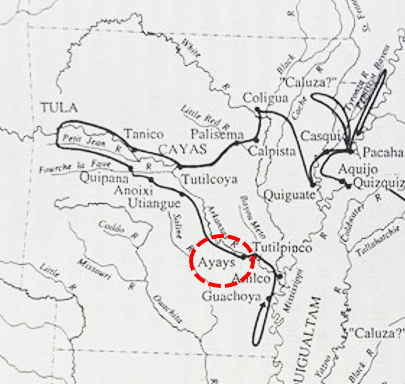
Figure 2: The polity of Ayays marked on Soto’s proposed route through Arkansas (Adapted from Hudson 1997)
The site sits on the route that Hernando de Soto’s entrada took down the Arkansas River in March of 1543 in the vicinity of a town called Ayays (Figure 2). Two different metal detector surveys at the site have yielded more than 50 brass and copper objects like this one, including tinkler cones, rolled beads, and bead blanks. A recent exploratory x-ray fluorescence (XRF) session revealed that most of these objects, including this triangular pendant, are primarily composed of copper but with significant amounts of zinc. This is the recipe for historic brass, which would have been produced in Europe during this time.
These two metal detector surveys are part of a larger decade-long effort to identify metal objects on late precolonial sites across the southeast (Figure 3). Teams of investigators have met with success at the Stark Farms site near Starkville, Mississippi; Marengo complex sites near Demopolis, Alabama; and the Glass site in Georgia (Cobb et al. 2024). Interestingly, this triangular brass pendant recovered from the Sarassa Lake site is identical in form to multiple specimens recovered at Stark Farms. All these sites are situated around the Soto route, making the metal finds potential objects left behind or traded by the entrada as it tore through the southeast.
Figure 3: Metal detector and shovel on a crop row at the Sarassa Lake site (3LI79; Photograph by Rachel Tebbetts)
Although the Sarassa Lake site is situated along the Soto route, there were other potential ways for European brass to make its way to the Lower Arkansas River before the middle 1600s. By the 1630s, the Spanish had established the town of St. Augustine on the Atlantic coast of modern-day Florida, and Franciscan missions had been set up as small operations in Indigenous towns across north central Florida and southern Georgia. Brass items could have moved through this mission system and then all the way out to Arkansas. Another even more distant possibility is that brass was traded down from French sources that made contact with Indigenous groups living around the Great Lakes by the 1630s. The Spanish also started using copper sources in Mexico to produce goods used by expeditionary forces later in the 1500s.
Whatever the source, Indigenous people living in villages along the Lower Arkansas River were using scraps of brass to create ornaments. Brass beads are known to have been strung on necklaces and used as hair adornments. Longer pieces of brass are known to have been shaped by Indigenous hands into bracelets. All of this was done by breaking down European objects such as kettles and candlestick holders, all of which were carried by participants in the Soto entrada that infiltrated Arkansas in the 1540s.
Regarding the study of these brass and copper objects recovered from Sarassa Lake and other sites across Arkansas, the next stepsare to submit them to more thorough compositional analyses utilizing XRF and potentially isotope-ratio mass spectrometry. The results of these analyses can then be compared with samples collected from other late precolonial sites across North America as well as in Europe and Mexico to better understand material sources and the movement of trade items.
References Cited
Cobb, Charles R., Dennis B. Blanton, Edmond A. III Boudreaux, et al. “Metal Detecting in the Wake of 16th Century a.d. Spanish Expeditions.” Journal of Field Archaeology 49, no. 8 (2024): 674–91. https://doi.org/10.1080/00934690.2024.2387887.
Hudson, Charles. Knights of Spain, Warriors of the Sun: Hernando de Soto and the South’s Ancient Chiefdoms. The University of Georgia Press, 1997.
Artifact of the Month Series
A first principle of archeology is that the significance of artifacts depends upon documented information about the context of their discovery. At what site was the artifact found? Can we figure out the age of the artifact? Where was it found in relation to site features (houses, trash deposits, activity areas, etc.) and the distribution of other artifacts? Only with knowledge of those facts can we assess further information about the manufacture and use of artifacts, and their role in other spheres of activity such as social organization, trade and exchange, and religious practice.
In this series, we feature select artifacts that are extraordinary both for the context of their discovery and for their unique qualities that contribute exceptionally important information about Arkansas culture and history. New artifacts will be added monthly. Find the list of artifacts here.